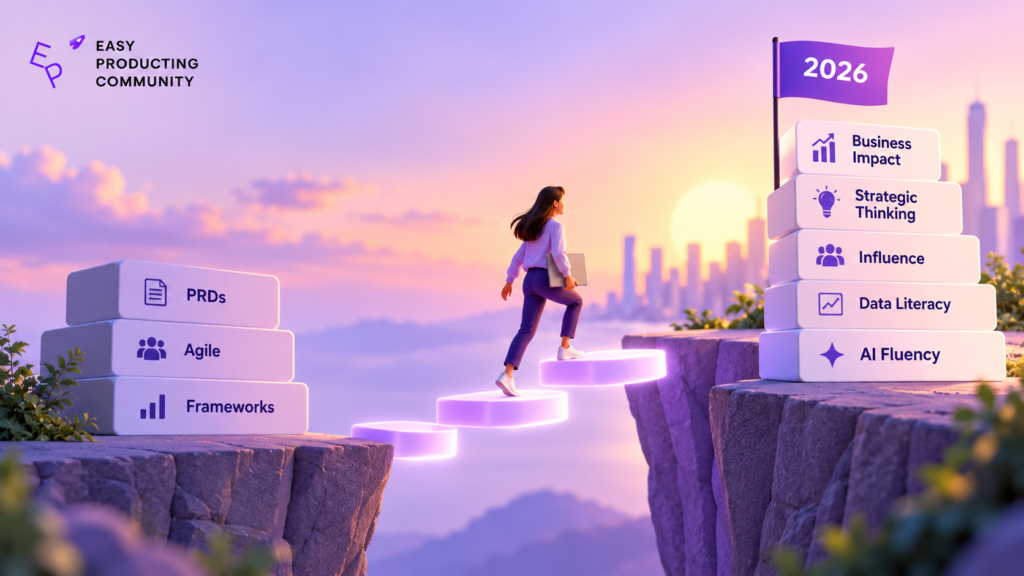
You know how to write a PRD. You’ve learned Agile, Scrum, and prioritisation frameworks. You might even have a few product case studies in your portfolio.
But here’s the question:
Is that enough to get hired or grow as a Product Manager in 2026?
Not necessarily.
Product Management is evolving, and so are employers’ expectations. According to Product Focus (2026), strategic thinking, communication, AI proficiency, and business acumen are increasingly important.
Frameworks are a good starting point. But companies also want Product Managers who can solve problems, make informed decisions, and connect product work to business results.
So what skills should you actually develop?
1. Business Thinking: Can You Connect Features to Revenue?
Imagine your team launches a feature everyone loves.
Customers are happy. Engineering delivered on time. But six months later, the feature hasn’t improved retention, revenue, or engagement.
Was it successful?
This is where business acumen matters.
Companies need Product Managers who understand how product decisions affect business outcomes, including pricing, retention, and profitability.
Research from Productside also highlights skills gaps in pricing and competitive analysis.
“A great PM doesn’t just understand what customers want. They understand how solving those problems creates business value”.
2. Data Literacy: Can You Make Decisions Beyond Gut Feelings?
You don’t need to become a Data Scientist to be a good Product Manager.
But you should know how to interpret product metrics, identify patterns, and use evidence to support decisions.
Imagine users are signing up for your product but leaving before completing onboarding.
Instead of immediately suggesting a redesign, a data-informed PM investigates where users drop off, what might be causing it, and which changes are worth testing.
That’s the difference between guessing and evidence-driven Product Management.
3. AI Fluency: Can You Use AI to Improve Your Work?
Knowing how to use ChatGPT isn’t the same as being AI-fluent.
AI fluency means understanding where AI can genuinely improve your product workflow.
Can you use AI to analyse customer feedback, identify recurring problems, explore opportunities or challenge prioritisation decisions?
And can you recognise when its recommendations are unreliable?
A 2026 AI PM Hiring Report highlights the importance of skills such as roadmapping, communication and prioritisation in AI-focused PM roles.
The goal isn’t to become a PM who uses AI for everything. It’s to become a PM who knows when AI adds value.
4. Strategic Thinking: Do You Know What Not to Build?
Product teams rarely run out of ideas.
Customers request features. Stakeholders have priorities. Competitors launch new products.
But time and resources are limited.
Strong Product Managers know how to evaluate opportunities, challenge assumptions, and make difficult trade-offs.
Sometimes, the most valuable product decision isn’t launching something new.
It’s deciding what not to build.
That’s what separates simply managing a backlog from contributing to product strategy.
5. Influence: Can You Lead Without Being Anyone’s Boss?
Here’s something that surprises many aspiring Product Managers.
You can be responsible for a product without directly managing the engineers, designers, or marketers working on it.
So how do you get everyone moving in the same direction?
Through communication, collaboration, and influence.
You need to explain problems clearly, listen to different perspectives, handle disagreements, and build alignment around shared goals.
Because even a brilliant product strategy means very little if your team doesn’t understand or support it.
So, What Should You Focus On?
If you’re an aspiring PM, don’t stop at learning frameworks. Practise using them to solve realistic business problems.
If you’re already a PM, look beyond delivery and ask yourself:
Am I improving my ability to make decisions, influence teams, and demonstrate business impact?
Your next career opportunity may depend less on how many frameworks you know and more on how effectively you apply your judgement.
Because in 2026, knowing how to manage a product is important. Knowing how to create value through that product is what makes the difference.