If you work in Product, you’ve probably heard this question:
“What should we build next?”
Sounds simple. But it rarely is.
Customers want one feature. Sales wants another. Engineering has technical priorities. Leadership has business goals.
And somehow, the Product Manager has to make sense of it all.
If you’re new to Product Management, this is where prioritisation comes in: deciding what your team should work on first, what can wait, and what perhaps shouldn’t be built at all.
Your product roadmap then communicates where the product is heading and what problems or opportunities your team plans to focus on.
So, where does AI fit into all of this?
Not by making the decisions for you.
But by helping you make better-informed decisions.
Imagine you’ve launched a product and customer feedback starts coming in:
“Can you add notifications?”
“Onboarding is confusing.”
“I wish I could export my data.”
Five comments are easy to read.
But what happens when you have 500?
This is where AI can help.
You can take customer feedback from surveys, reviews, support tickets, or interviews and use AI to identify recurring themes, common problems,s and patterns.
Instead of hundreds of disconnected comments, you might discover:
32% → Users struggle with reminders
24% → Users want better reporting
18% → Users find onboarding confusing
You’ve gone from:
Feedback → Signals → Opportunities → Roadmap
You could even turn those signals into potential product tickets for your team to investigate.
But remember: if 100 customers ask for the same feature, that doesn’t automatically mean you should build it.
AI can find the signal. You still need to understand what the signal means.
Now imagine your team has three ideas:
A: Improve onboarding
B: Build an AI assistant
C: Create an analytics dashboard
Which comes first?
Product Managers often use prioritisation frameworks such as RICE, MoSCoW, or Value vs Effort.
But forget the terminology for a second.
You’re essentially asking:
How many customers will this help? How valuable could it be? How difficult will it be to build? What evidence tells us people actually need it?
AI can help bring that evidence together.
Instead of asking:
“AI, which feature should we build?”
Try:
“Compare these opportunities using our customer feedback and product goals. What evidence supports each one? What assumptions are we making? What information is missing?”
Now AI isn’t making the product decision.
It’s helping you think through the decision.
A roadmap can easily become:
January → Notifications
February → Dashboard
March → AI assistant
But what problems are those features actually solving?
A better starting point might be:
Problem: New users are abandoning onboarding.
Goal: Improve activation.
Evidence: Customer feedback shows users struggle during setup.
Possible solutions: Simplify onboarding, provide guidance,e or personalise setup.
AI can help connect:
Customer Problem → Evidence → Opportunity → Solution → Outcome
Now your roadmap doesn’t just tell people what you’re building.
It explains why it matters.
No.
AI doesn’t know everything about your customers, business, technical constraints, or product strategy.
Think of it as a product thinking partner.
It can organise information, identify patterns, compare options,s and challenge assumptions.
But you and your team still make the call.
If you’re new to Product Management, start small. Take some customer feedback and ask AI:
“Group this feedback into common customer problems. Show me the strongest themes and what I should investigate before deciding what to prioritise.”
Then question the output. Talk to your customers. Look at your product data. Speak with engineering and design.
Because the goal isn’t to get AI to think for you.
It’s to give yourself better information to think with.
Back to Blog
Product Management 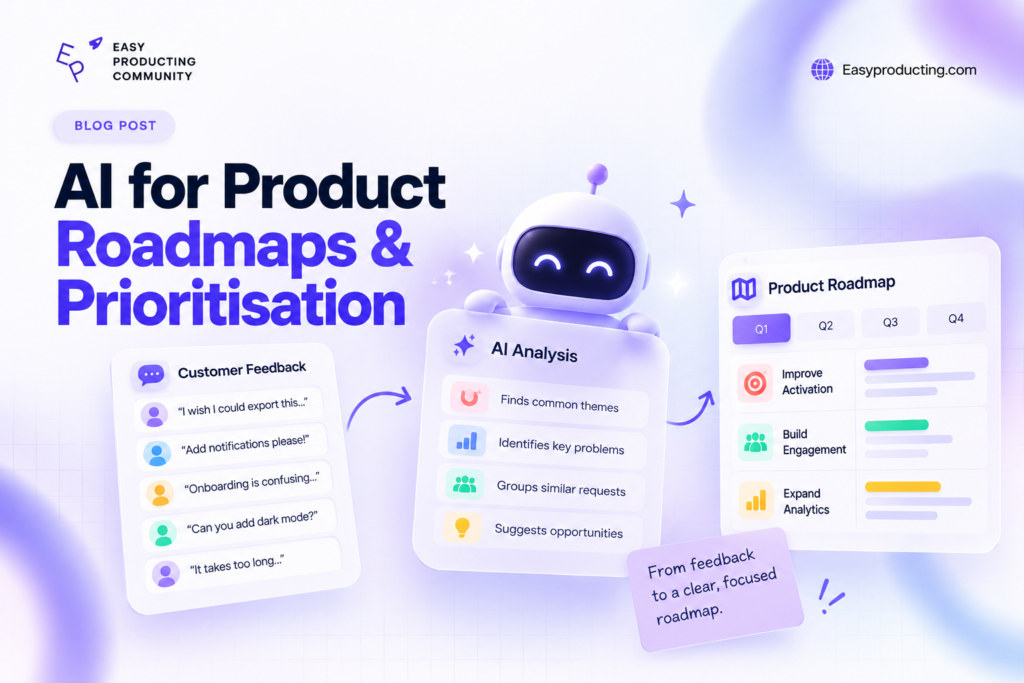
AI for Roadmaps and Prioritisation