
Product Managers have more data, AI tools and customer insights than ever before. Yet making the right product decisions isn’t getting easier.
Atlassian’s State of Product 2026 highlights the challenge: 84% of Product Managers worry their products may fail, while 80% of teams don’t involve engineering early enough.
So what’s making Product Management harder in 2026?
1. Product Strategy & Prioritisation
Product teams don’t lack ideas — they lack time and resources to pursue all of them.
The challenge is deciding what deserves attention now.
Strong product strategy means looking beyond feature requests and prioritising opportunities based on customer impact, business value, evidence and strategic alignment.
The best Product Managers aren’t asking, “What can we ship next?”
They’re asking, “What’s the most valuable problem we can solve next?”
2. Getting Real Value From AI
AI in Product Management has become mainstream, but much of its value still comes from drafting PRDs, summarising research and speeding up documentation.
The bigger opportunity is AI-assisted decision-making.
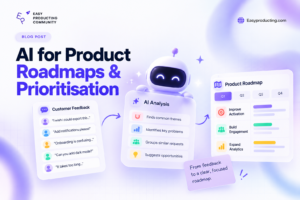
Can AI help identify patterns in customer feedback? Challenge assumptions? Improve product discovery? Support prioritisation?
The goal isn’t to let AI make product decisions. It’s to use AI to help Product Managers make better-informed decisions faster.
3. Delivering Business Impact
Shipping isn’t the same as succeeding.
Product Managers are increasingly expected to connect product decisions to business outcomes — whether that’s activation, retention, revenue, conversion or customer satisfaction.
The question after a launch shouldn’t just be:
“Did we ship it?”
It should be:
“What changed because we shipped it?”
That’s the difference between being output-driven and outcome-driven.
4. Cross-Functional Collaboration
Great products aren’t built by Product Managers alone.
They require strong product-engineering alignment, design collaboration and input from marketing, sales, data and customer-facing teams.
When these functions are involved early, teams make better decisions and reduce costly hand-offs later.
The Product Manager’s role isn’t to have all the answers. It’s to create clarity and alignment around the right problem.
The PM Skill That Matters Most in 2026
AI, business pressure and faster delivery cycles are changing Product Management.
But one skill sits underneath all of them:
Decision quality.
The strongest Product Managers will be those who can decide what to build, what not to build, when to experiment and where limited resources can create the greatest customer and business impact.
So, Product Mates — what’s your biggest challenge right now: prioritisation, AI, business impact or cross-functional collaboration?