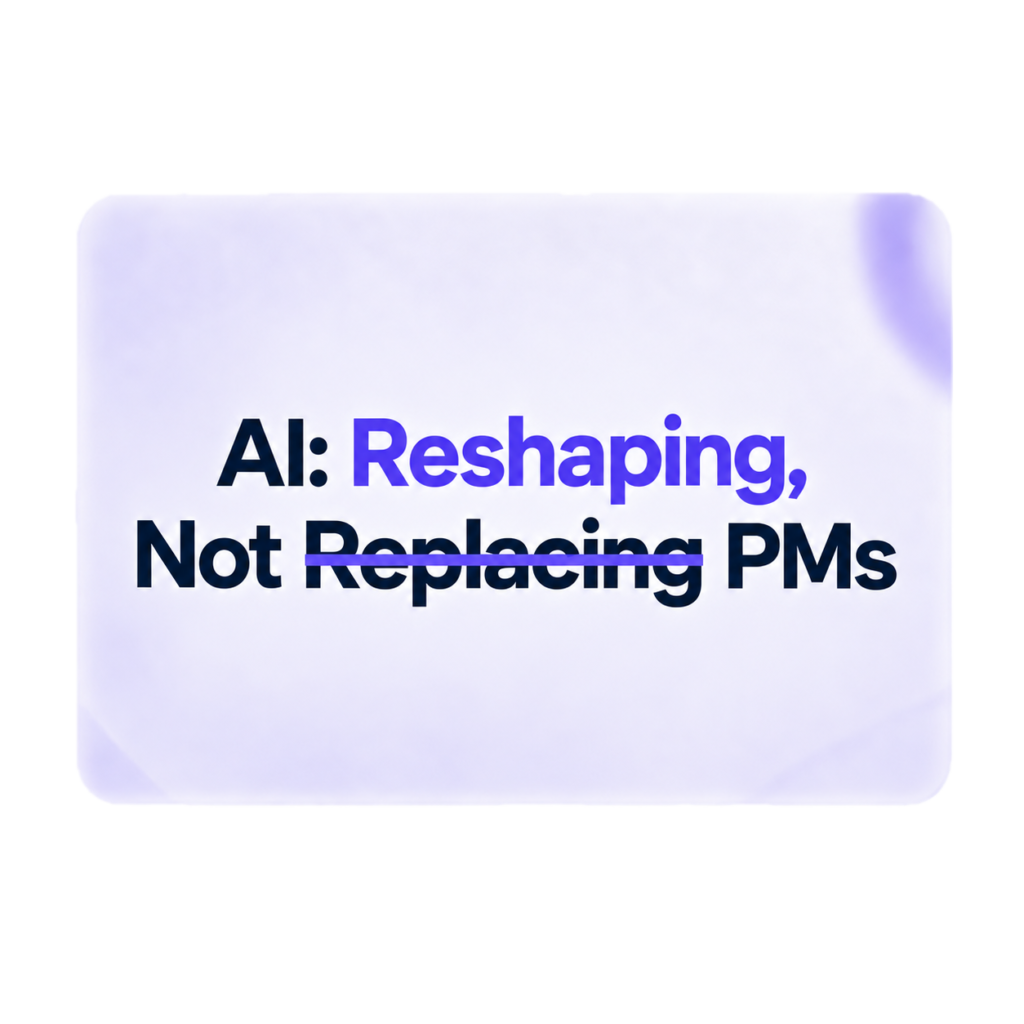
The conversation about AI and product management is often framed as a dramatic choice: either AI will replace product managers, or nothing fundamental will change.
The evidence points to a more nuanced reality.
AI is changing the content of product work. It can accelerate research, produce first drafts, organise feedback and make data easier to interrogate. That does not automatically eliminate the PM role. It changes where a product manager creates value—and raises the cost of remaining focused only on outputs that software can generate quickly.
The future belongs neither to the PM who ignores AI nor to the PM who delegates every decision to it. It belongs to product managers who use AI for leverage while strengthening their judgment, customer understanding and ability to align people around difficult decisions.
What the evidence actually tells us
The World Economic Forum’s Future of Jobs Report 2025 estimates that structural changes in the labour market could create 170 million roles and displace 92 million by 2030. That represents a projected net increase of 78 million jobs—not an overall net loss. The same report says 39% of workers’ existing skills may change or become outdated by 2030.
This distinction matters. The central issue is not simply whether jobs will exist. It is whether professionals will develop the skills required as their work changes.
LinkedIn’s 2025 research reinforces this point. It identifies AI literacy as one of the fastest-growing skills across multiple regions and job functions. Its broader Work Change Report estimates that 70% of the skills used in most jobs could change by 2030, with AI acting as a major catalyst.
At the same time, we should be careful about declaring that AI has already caused widespread job losses. A March 2026 analysis from the US Federal Reserve, using Lightcast job-posting data and US Census survey data, found no evidence so far that firms or industries with higher AI adoption had reduced overall job postings. The researchers noted that organisations may instead be changing their hiring priorities.
For product managers, the most responsible conclusion is this: the role is being reshaped faster than it is being erased.
Product tasks AI can accelerate today
AI is especially effective when a task involves transforming a large amount of information into a usable first pass.
Research synthesis
Product managers can use AI to summarise interview transcripts, group recurring themes and compare competitor information. This can reduce the time spent organising raw material. However, AI does not know which comment reflects a serious churn risk, which customer is unusually influential, or which insight contradicts the team’s assumptions. The PM must still validate the source material and interpret what matters.
First drafts of PRDs and user stories
Generative AI can quickly produce a PRD outline, acceptance criteria, edge cases,s or questions for engineering. This is useful, but the quality of the draft depends on the quality of the context. A polished document is not the same as a sound product decision.
Meeting notes and routine documentation
Transcription, summaries and action-item extraction are increasingly straightforward to automate. PMs should use the time saved to resolve ambiguity, follow up on commitments and improve decisions—not simply attend more meetings.
Feedback organisation
AI can label support tickets, survey responses and reviews at scale. A PM still needs to check misclassifications, identify missing customer segments and distinguish a loud complaint from a strategically important pattern.
Exploratory data analysis
Natural-language interfaces make it easier to ask questions about product data. They can help more PMs explore funnels and trends without starting with a complex query. But interpretation remains critical: correlation is not causation, an incomplete event taxonomy can mislead, and a statistically visible change may not be commercially important.
The work AI does not own
The more routine production becomes automated, the more visible human judgment becomes.
Choosing under uncertainty
Product decisions rarely arrive with perfect data. A PM may need to balance customer urgency, technical risk, revenue, accessibility, regulatory, and team capacity. AI can structure those factors, but accountability for the trade-off remains human.
Building customer understanding
A transcript can capture words. It may not fully capture hesitation, politics inside a customer’s organisation, or the difference between a feature request and an underlying need. Strong product managers combine evidence with live curiosity and empathy.
Creating cross-functional alignment
Roadmaps are delivered through people. Gaining the trust of engineering, design, commercial, legal and leadership teams requires credibility, context and relationships. AI may help draft the message, but it cannot own the relationship.
Taking responsibility
Someone must decide what success means, make the call, monitor the consequences, and change direction when the evidence demands it. AI can support responsibility; it cannot absorb it.
Evaluating AI products
PMs working on AI-enabled products need more than prompting skills. They should understand evaluation criteria, failure modes, hallucination risk, privacy, bias, human oversight, cost, latency,y and when a deterministic experience is more appropriate than a generative one.
Two directions for the modern PM
The distinction that matters is not simply junior versus senior. It is the difference between producing outputs and improving outcomes.
An output-focused PM is valued mainly for documents, ceremonies, tickets, ts and status updates. Those activities may still be necessary, but many are becoming faster to produce with AI.
An outcome-focused PM uses those artefacts as tools. Their deeper value comes from understanding the problem, making trade-offs, testing assumptions, aligning the organisation and learning from results.
Early-career PMs are not locked out of this shift. Strategy is not reserved for people with a director title. A junior PM can demonstrate strategic thinking by asking better questions, connecting a feature to a customer problem, identifying risk early and explaining what changed after a launch.
A practical 90-day repositioning plan
Days 1–30: Audit and automate responsibly
Track how you spend your working week.
Identify repetitive research, documentation, and reporting tasks that AI can accelerate.
Choose tools approved by your organisation and never expose confidential customer or company data without permission.
Verify every AI-generated claim, number, and quotation against its source.
Reinvest the time saved in customer conversations and problem discovery.
Days 31–60: Build strategic range
Write a short opportunity memo about an underserved customer problem.
Improve one weak product metric or evaluation method.
Join customer, sales, or support conversations and record what the dashboard misses.
Learn the fundamentals of AI product evaluation, including quality, safety, latency,y and cost.
Practise presenting a recommendation with options, evidence, risks and a clear decision.
Days 61–90: Make your value visible
Lead one product decision from problem framing through measurement.
Share what you learned, including evidence that changed your mind.
Build a stronger working relationship with an engineering, design, data, TA, ta or commercial partner.
Create a case study showing an outcome you influenced—not just documents you produced.
Develop a personal workflow in which AI handles suitable first-pass work while you retain validation and accountability.
Final takeaway
AI will make some familiar PM tasks cheaper and faster. That is not a reason to panic, and it is not a reason to become complacent.
The strongest response is to move up the value chain: automate routine production, investigate customer problems more deeply, improve your judgment, learn how to evaluate AI systems, ems and become someone teams trust when the answer is unclear.
The question is no longer, “Can AI write this document?”
The better question is, “Can I make a better product decision with the time AI gives me back?”