AI is supposed to make work easier.
For many technology professionals, it is certainly making work faster. Research can be summarised in minutes, first drafts appear in seconds and ideas can be tested more quickly than before.
Yet faster work has not necessarily created happier or more confident teams.
Lenny’s Newsletter’s 2026 survey of technology workers reveals a complicated reality: many people feel more capable because of AI, but they also feel more exhausted, uncertain and pressured. The same tools helping people achieve more are quietly raising expectations for how much they should produce.
For product professionals, this raises an important question:
Is AI helping us work better, or is it simply helping us work faster inside an increasingly unsustainable system?
One technology, two very different experiences
According to the survey, 49% of respondents said AI had amplified them professionally, helping them do more or produce better work. Another 27.4% felt their role was being redefined without viewing the change as clearly positive or negative.
However, almost one in five felt destabilised or diminished. They were less certain about their professional value, responsibilities and place within the changing workplace.
The divide is not simply between people who use AI and those who do not. It is between people who feel they have gained greater control through AI and those who feel that AI is changing their work without giving them enough support, clarity or agency.
One group sees possibility. The other sees instability.
Productivity is rising, and so is burnout
The survey found that 82% of respondents believed AI was making them measurably better at their jobs. Nearly half said it was helping them “very much” or “extremely.”
But significant burnout rose from 44.7% to 55.7% in one year, while career optimism fell from 54.8% to 48.7%.
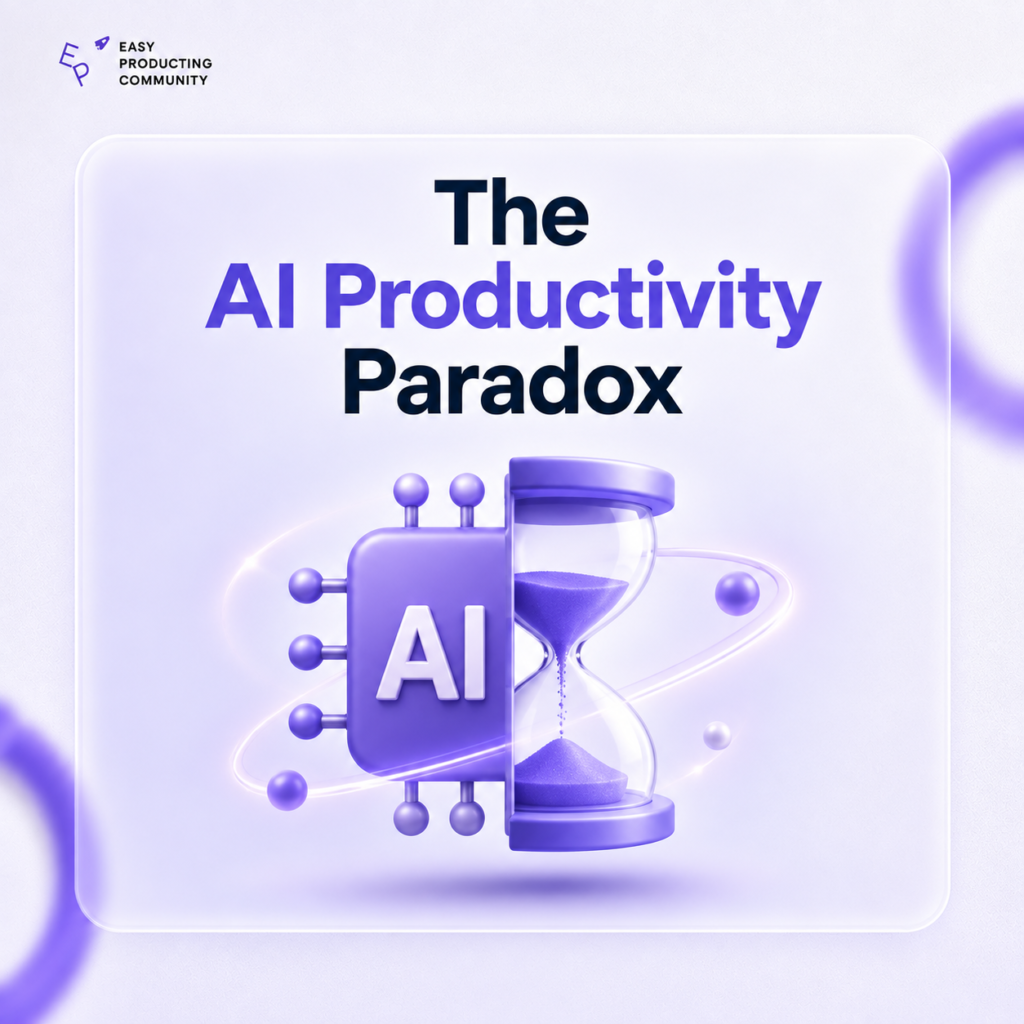
This is the productivity paradox facing many technology teams: people can produce more while feeling worse.
AI reduces the time needed for individual tasks, but organisations may respond by increasing targets, adding responsibilities and shortening timelines. The time saved is not always returned to employees for deeper thinking, learning or recovery. Instead, it becomes the new minimum expectation.
A product manager who previously prepared one detailed analysis may now be expected to produce three. A designer who generates concepts faster may face more revision cycles. A researcher who summarises interviews quickly may be asked to manage more studies.
Efficiency becomes more work rather than better work.
The real fear is not simply job replacement
Only 22% of respondents identified losing their job directly to AI as a major worry. Far more were concerned about being expected to do more for the same pay, maintaining an unsustainable pace and watching the quality of their work decline.
Many professionals are not imagining a future in which AI suddenly takes their chair. They are experiencing a present in which AI increases the workload attached to that chair.
For product teams, the danger is allowing speed to become the main measure of value. More specifications, experiments and releases may look like progress, but volume does not automatically produce successful products.
Good product work still requires time to investigate problems, speak with customers, challenge assumptions and consider the consequences of decisions. These activities may not look impressive on a productivity dashboard, but they often determine whether a team builds the right thing.
Faster output does not guarantee better thinking
AI can generate documents, organise information and explore options. Used well, it frees product professionals to focus on judgment and strategy. Used carelessly, it can weaken those same skills.
When every question is handed immediately to an AI assistant, teams spend less time developing their own perspective. A polished response can appear more reliable than it is, while summaries can remove valuable context from customer conversations.
Product professionals must distinguish between tasks AI can accelerate and responsibilities people must continue to own:
AI can draft a PRD, but the PM must decide whether the feature deserves to exist.
AI can summarise customer feedback, but the team must determine which problems matter strategically.
AI can identify data patterns, but a human must question the evidence, interpret the context and remain accountable for the decision.
Professionals early in their careers need stronger development
The survey found that individual contributors early in their careers were among those most likely to feel professionally destabilised.
Experienced professionals use AI alongside years of judgment, domain knowledge and organisational context. New professionals may be asked to use the same tools before developing the foundations needed to evaluate their output.
There is also a long term risk. Research summaries, documentation and basic analysis have traditionally helped junior employees learn how product organisations work. If these tasks disappear without better learning opportunities replacing them, companies may remove the pathway through which future senior talent develops.
AI adoption should therefore strengthen mentoring, customer exposure, critical thinking and supervised decision making, not replace them.
Managers shape whether AI empowers or exhausts
One of the survey’s most actionable findings was that manager quality remained a major influence on burnout and job satisfaction. Yet only around a quarter of respondents rated their managers as highly effective.
An AI strategy cannot be separated from a management strategy. Managers decide whether time saved becomes breathing room or additional pressure. They also shape whether employees can question AI generated work and experiment without fear.
Product leaders should ask:
Is AI improving outcomes or merely increasing output?
Where is it creating rework or reducing quality?
Are expectations rising faster than people can sustainably meet them?
Are junior employees still learning the fundamentals?
Does the team have protected time for deep thinking?
Use AI to create better work, not endless work
The answer is not to reject AI. It is to use it with clearer boundaries and stronger judgment.
Automate repetitive preparation, but protect reflection. Treat AI output as a starting point and verify important claims. Measure customer and business outcomes rather than documents, tickets and activity. Most importantly, do not fill every hour saved with another deliverable.
The latest workforce findings do not present AI as either a miracle or a disaster. They show people experiencing both possibility and pressure.
The organisations that benefit most will not simply adopt the most tools. They will decide what those tools are for. They will use AI to reduce unnecessary effort, improve decisions and create more space for the deeply human parts of product development.
Because the real promise of AI at work should not be unlimited production.
It should be giving people more time to do work that matters.
Source and editorial note
This original Easy Producting analysis draws on findings reported in Lenny’s Newsletter’s 2026 survey of technology workers.